Minimalist Mosque Icons: Precision Tools for Modern Design Projects
In the landscape of contemporary visual communication, the need for versatile, high-quality iconography is paramount. Whether crafting a user interface for a mobile app, designing a social media campaign, or preparing print materials for an event, designers seek assets that are both aesthetically precise and functionally adaptable. A specialized set of Mosque Icons, designed in a clean minimalist style, addresses this need directly, offering a resource that transcends specific religious contexts to become a broader tool for representation, culture, and community.
The Core Characteristics of a Modern Icon Set
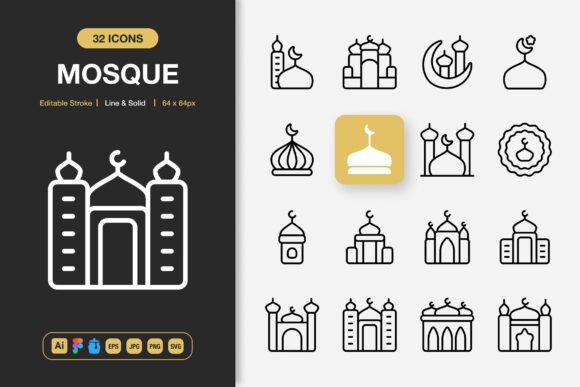
What defines a truly useful icon collection in today’s design environment? Beyond mere visual appeal, practical considerations dominate. The mentioned set embodies several key characteristics that make it suitable for a vast array of projects. First is the dual offering of Line and Solid styles. This provides immediate stylistic flexibility, allowing a designer to match the icon weight to the overall design language—using delicate line art for a sophisticated website or bold solid forms for a striking poster.
Another fundamental feature is the editable stroke. For designers working in vector environments, this control is invaluable. It means the line thickness, curvature, and joinery can be modified without losing integrity, ensuring the icons integrate seamlessly into existing brand guidelines or layout specifics. This level of editability speaks to a professional understanding of the design workflow, where assets must adapt, not dictate.
Technical Quality and File Format Ecosystem
The promise of high quality is substantiated by the included file formats. A comprehensive suite such as Adobe Illustrator source files, Figma files, EPS, SVG, and PNG with transparency covers nearly every professional application. The inclusion of an Iconjar file speaks directly to efficiency, enabling quick organization and access within design software. The presence of a Figma file acknowledges the shift towards collaborative, web-based design tools, while JPG and EPS ensure backward compatibility and print readiness.
This multi-format approach removes a common bottleneck in projects: asset conversion. When a designer or team receives a single set that delivers ready-to-use files for web (SVG, PNG), print (EPS, JPG), and prototyping (Figma, Illustrator), the workflow accelerates significantly. The readme.txt file, often overlooked, is a subtle nod to user experience, guiding even those less familiar with vector assets towards successful implementation.
Transforming Projects Through Minimalist Design
Minimalist icon design is not merely a trend; it is a functional choice. Its advantages are clear across media. On websites and mobile apps, minimalist icons reduce cognitive load for users, conveying meaning quickly and without visual clutter. In print media—flyers, banners, posters—they offer clarity and impact, often working better at smaller sizes or when viewed from a distance. For infographics, clean icons allow data and narrative to take center stage, acting as supportive visual cues rather than competing elements.
The specific application of a Mosque Icon set, when approached with this minimalist philosophy, extends its utility. Such icons can serve in educational materials to illustrate cultural or architectural topics, in community event promotions, in travel agency interfaces, or in any project requiring symbols of specific buildings, community spaces, or cultural landmarks. The minimalist treatment ensures the icon reads as a clear, recognizable form, free from unnecessary decorative detail that might pigeonhole it into a single style or era.
Real-World Use Cases and Applications
Consider a city tourism department creating a multilingual visitor app. Icons representing points of interest are needed. A minimalist mosque icon, available in line and solid style, could clearly mark historical mosque locations on a map, its form distinct from icons for museums, parks, or restaurants. Its editable stroke allows the design team to adjust it to match the precise line weight used for all other map icons, maintaining visual consistency.
For a publisher producing a series of children’s books about world cultures, the PNG transparency files are crucial. The icons can be easily placed over illustrations or textured backgrounds without needing complex masking. The high-quality vector source means the art department can also create derivative artwork, perhaps combining the icon with other elements, without any loss in resolution.
A social media manager running a campaign for an interfaith community event might use the solid-style icons in a series of graphic posts. The SVG files ensure the graphics look perfect on any screen, while the easy drag-and-drop nature of the provided PNGs allows for quick composition in simpler design tools. The icons act as immediate visual shorthand, communicating inclusivity and specific venue types efficiently.
Beyond the Niche: Universal Design Principles
While the subject matter of these icons is specific, their design execution makes them a case study in universal icon set principles. The 100 customizable icons suggest a complete, not token, offering. Completeness is key for designers; they cannot build a coherent interface or campaign with a handful of symbols. A robust set encourages full adoption.
The easy drag-and-drop aspect acknowledges the spectrum of users. Not every person implementing icons is a seasoned graphic designer. A hobbyist creating a flyer for a local club meeting, a researcher adding visuals to a presentation, or a business owner updating their website banner can all benefit from assets that are genuinely easy to use. This accessibility expands the real-world relevance of the set far beyond professional design studios.
Considerations for Selection and Implementation
When evaluating any icon set for project use, several considerations come to the fore. One is stylistic coherence: do the icons share a common visual language? A minimalist set with consistent line treatment, proportions, and detail level naturally provides this. Another is format suitability: does the set cover the platforms you work in now and might migrate to in the future? The listed file ecosystem demonstrates foresight in this area.
A practical consideration is the balance between specificity and versatility. An icon of a mosque, if overly detailed or ornate, might only be usable in contexts directly discussing that specific architecture. A minimalist version, however, can symbolize a place of worship, a community hub, or architectural beauty in a broader sense. This versatility is a significant advantage, allowing the assets to serve in primary and secondary roles across different projects.
Finally, the inclusion of source files like Adobe Illustrator and Figma files is a strong indicator of professional grade. It respects the designer’s need to own the creative process, allowing for modification, recombination, and true integration into a unique design vision. It transforms the icons from static assets into dynamic design components.
The Impact on Creative Workflows
Integrating a well-constructed icon set into a creative workflow can change the trajectory of a project. It saves the considerable time often spent searching for disparate assets, converting file formats, or attempting to create consistent custom icons from scratch. This time savings redirects energy towards higher-value creative tasks: layout, user experience, narrative, and branding.
For teams, consistency is automatically bolstered. If all members are using the same core set of Mosque Icons from the same source files, the visual output across different deliverables—a website page, a mobile app screen, a printed brochure—will maintain a familial relationship. This is crucial for brand integrity and user recognition.
The minimalist approach also future-proofs the assets to a degree. Design trends evolve, but clarity and simplicity have enduring value. Icons stripped of extraneous detail are more likely to remain useful across design style refreshes, as they can be colored, textured, or animated to suit new visual directions without needing a fundamental redraw.
In essence, a focus on minimalist icon design, exemplified by this specific set, is a focus on communication efficiency and creative flexibility. It provides designers, educators, creators, and businesses with a toolkit that is immediately functional yet deeply adaptable, ready to enhance the next project, whatever its medium or message may be.