Video Game Icon: Turning Playful Design into Real-World Impact
Think about the last time you noticed a tiny graphic that made an app feature instantly recognizable, or a game menu that felt polished and professional without saying a word. That’s the language of icons, and when it comes to digital experiences tied to gaming, a well-crafted Video Game Icon does more than decorate a screen — it shapes how users feel, navigate, and connect. It’s not just about slapping a controller symbol somewhere and calling it a day. It’s about tapping into a visual vocabulary that millions of people already understand and love, then infusing your project with that same energy in a way that feels fresh and intentional.
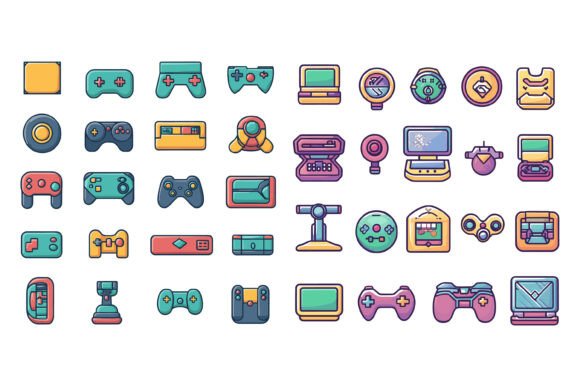
For designers, marketers, developers, and content creators, having access to a professionally built illustration set that revolves around gaming symbolism means everything. You’re not just downloading a file; you’re unlocking a toolkit that respects your time, adapts to Mac and Windows workflows, and hands you complete control over colors, shapes, and layers. The set includes AI, EPS, and JPG formats, so whether you’re refining a vector masterpiece or dropping a ready-to-use image into a presentation, you’re covered. But the real story here isn’t the file types — it’s where those icons travel next and who they help along the way.
Where a Video Game Icon Finds Its True Purpose
It’s easy to assume that gaming icons belong exclusively in video games, but the reality is far broader. An independent game developer, for instance, might use them to prototype a skill tree interface or to quickly build a settings menu that doesn’t feel generic. They need something that resonates with players, something that says “I built this with care” even before the gameplay begins. With this set, they can drag, drop, and customize icons that match their game’s mood — dark fantasy, retro arcade, futuristic racer — without spending days on pixel-perfect outlines. The files are organized neatly, so finding the exact trophy, joystick, or health pack icon doesn’t become a treasure hunt of its own.
Then there’s the app designer working on a fitness app that gamifies workouts. Suddenly, a Video Game Icon of a star, a level-up badge, or a classic heart container becomes a reward signal that users instantly get. It’s a shortcut to motivation. Because the icons are vector-based and fully editable, the designer can tweak stroke weights, swap colors to fit the brand palette, and even combine elements to create something completely new. The perfection in details means no jagged edges when scaled up for a splash screen or down for a tiny notification badge. That consistency across sizes is what separates a professional app from a hobby project.
Different Audiences, Different Stories
A marketing agency crafting a campaign for a gaming peripheral brand doesn’t need icons that just sit there. They need assets that can live across social media graphics, email headers, print brochures, and even trade show banners. The JPGs are ready for web use; the AI and EPS files open right up in Adobe Illustrator for high-resolution print tweaks. The layer structure is clean and intuitive, which means even a team member who isn’t a dedicated illustrator can jump in, isolate a gamepad icon, recolor it to match the campaign’s neon theme, and export it without breaking the file. This flexibility slashes revision cycles and keeps creative momentum rolling.
Educators and instructional designers have discovered their own uses, too. Gamification in e-learning isn’t new, but poorly executed visuals can make a course feel childish rather than engaging. A history module that rewards learners with a sleek achievement medal icon or a quiz interface that uses a subtle health bar icon to show progress feels mature, even for an adult corporate audience. The icons, designed with perfection in details, bring a sense of polish that respects the learner’s intelligence. Because the set works on both Mac and Windows, it doesn’t matter what device the instructional team prefers — everyone can open and edit the files seamlessly.
Streamers and content creators often overlook how much a cohesive set of gaming icons can elevate their brand. Overlays, alert boxes, offline screens — these are all small canvases where a recognizable icon carries the personality of the channel. With the editable AI files, a streamer can match the icon colors to their logo, add a subtle glow effect, or rearrange layered elements to create a unique subscriber notification icon that nobody else has. There’s no need to commission custom work for every tiny asset when you have a high-quality base set that’s built to be modified.
Practical Applications That Go Beyond the Screen
Print might seem like an afterthought in a digital-first world, but gaming conventions, tournaments, and community events are full of physical banner stands, lanyards, sticker sheets, and info cards. A tournament organizer designing a player pass can use the same video game icons to indicate game stations, rest zones, or prize areas. The illustrator files ensure that when blown up to poster size, every curve remains crisp. The organized file structure lets the design team quickly locate icon variations without sifting through a flattened mess. That kind of practical time-saving matters when you’re juggling dozens of print deadlines.
Another frequent scenario lands in UI/UX design for automotive or smart TV interfaces, where gaming icons help categorize entertainment options. A car manufacturer’s rear-seat entertainment system might use a child-friendly but modern-looking controller icon to highlight the games section. The ability to split apart the layers and recolor them to match the vehicle’s interior lighting scheme isn’t just a nice-to-have — it’s what allows the design to feel integrated rather than pasted on. The AI and EPS files support this customization without adding complexity.
Consider the small business owner who runs a retro gaming café and wants to spice up their menu board, social media posts, and loyalty punch cards. Without design staff, they need something that works out of the box but can still be personalized. The JPG files provide an immediate solution for quick posts, while the editable AI versions mean they can hand the assets to a freelance designer and say “make these feel more 8-bit” or “swap the gold to match our shop’s teal accent.” The owner doesn’t need to understand layers; they just need to know the foundation is solid, which these collections provide.
Considerations Before You Jump In
No set of assets can be everything to everyone, and while this AI EPS collection is versatile, it’s wise to think about how you’ll approach it. The icons are meticulously organized with a clear layer structure, but if your workflow relies entirely on raster-based software like Photoshop without Illustrator, you’ll want to use the provided JPGs or convert the EPS files carefully. The editable magic truly shines inside vector editing tools, so some learning curve exists if you’re brand new to that environment. Fortunately, the straightforward naming and grouping make it easy to open a file and immediately see which layers control which parts of an icon.
Another practical note involves color customization. While the files are designed for quick recoloring, take a moment to understand how strokes and fills work in AI format before you accidentally unlink a gradient that gives an icon its depth. It’s not a flaw of the design — it’s simply how complex vector artwork functions. The upside is that once you get the hang of it, you can produce style variations across an entire set in minutes, something that would take hours if you had to redraw from scratch.
If you’re working on a project that demands extremely niche or hyper-specific imagery — say, a futuristic ray gun that doesn’t exist in the set — remember that these icons serve as both standalone assets and building blocks. Because the layer structure is neat, you can pull apart components from multiple icons and reassemble them. That sword hilt from one file combined with the energy glow from a power-up icon might birth exactly what you need. It’s a playful, experimental approach that many designers overlook, and it leverages the precision built into the illustrations.
Why Perfection in Details Changes Your Outcome
It’s tempting to think of icons as quick, disposable things, but anyone who has stared at a blurry health bar or a misaligned icon on a high-resolution display knows the pain. The attention to detail in this set — consistent line weights, harmonious curves, intentional spacing — means you’re not constantly fixing artifacts before you can use the asset. When an icon looks professionally crafted at 16×16 pixels and still holds up on a 4K screen, you’ve saved yourself from the dreaded “we need this sharper” feedback loop. That’s a benefit that crosses every industry, every scenario, and every skill level.
For infographic designers, these icons do double duty. A Video Game Icon of a treasure chest or a coin stack can represent in-game economies, but it can just as easily illustrate a business concept about gamified customer loyalty or reward programs. The semantic flexibility of gaming visuals is one of their strongest traits — they carry literal meaning in one context and metaphorical weight in another. Having files that are perfectly detailed and consistent allows that shift to happen without awkward visual compromises.
Embracing the Editable Advantage
The real freedom here is in the phrase “you can edit it, change colors and modify the icon so easily.” That’s not a minor feature — it’s the entire philosophy behind why these collections exist. You might start with a standard heart container icon for a health app, then decide you want a cracked, half-empty version to show depleted energy. Because you’re working with editable layers and not a flattened raster, that transformation becomes a matter of tweaking paths, not starting over. The design remains yours, born from a base that’s already done the heavy lifting of proportions and perspective.
Teams working across platforms appreciate that the files are built for both Mac and Windows users. There’s no conversion headache when a colleague on a different operating system needs to access the original vector. The experience is smooth, and the organized file structure means everyone finds the right icon quickly, whether they’re in a rush to meet a product launch deadline or leisurely exploring creative options for a side project.
From mobile game UI to event signage, from corporate training modules to personal streaming overlays, the common thread is that a high-quality Video Game Icon set removes friction. It lets you focus on the message, the experience, the story you’re telling — while the visual language does its job quietly, effectively, and beautifully. When you have that kind of resource in your toolkit, the next spark of inspiration isn’t met with a blank canvas and dread; it’s met with a header click and an eager “what can I make today?”