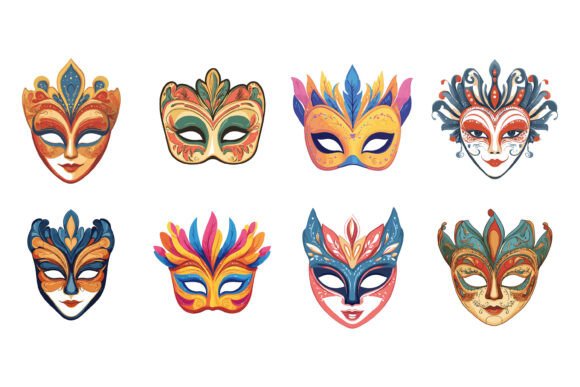
The Enduring Power of Carnival Masks in Modern Design Projects
There's something undeniably magnetic about Carnival Masks. Long before digital design tools existed, these ornate creations told stories of mystery, celebration, and transformation. Venetian artisans spent decades perfecting their craft, layering papier-mâché and gold leaf into expressions that could stop a crowded piazza in its tracks. Today, that same visual drama finds new life in a completely different medium: vector illustration sets that bring centuries of artistic tradition directly into your creative workflow.
Whether you're designing for a Mardi Gras festival poster or building an app that needs a touch of theatrical flair, the right visual assets transform ordinary projects into memorable experiences. Understanding what makes an illustration collection genuinely useful, rather than just decorative, changes how you approach everything from branding campaigns to social media graphics.
Why Carnival Masks Continue to Captivate Audiences Across Media
The psychological pull of Carnival Masks runs deeper than seasonal festivities. They represent duality, liberation, and the thrill of transformation. When you strip away recognizable facial features, something remarkable happens: viewers project their own emotions onto the image. This makes mask imagery incredibly versatile in commercial design. A well-designed mask illustration can evoke playfulness in one context and sophisticated elegance in another, depending entirely on how you deploy it.
Designers who work with event branding immediately recognize the value here. A music festival, a theatrical production, or even a high-end masquerade-themed corporate gala all demand visuals that communicate more than just date and venue information. The imagery needs to promise an experience. Carnival Masks do exactly that by tapping into cultural associations with Venice, Rio de Janeiro, New Orleans, and countless other celebrations where masks play a central role in the visual identity of the event itself.
What Makes Professional Vector Illustrations Essential for Your Toolkit
Resource files come in many forms, but not all of them are created with the working designer in mind. When a collection specifies that it includes AI EPS and JPG formats, it signals something important about versatility. Adobe Illustrator files give you complete control over every anchor point, curve, and color fill. EPS format ensures compatibility across different software ecosystems, and JPG provides a ready-to-use raster option when you need quick placement without editing.
This combination matters because design projects rarely follow a single predictable path. You might start by using a JPG preview in a mood board, then switch to the AI file for detailed customization when the concept gets approved. Having all three formats available from the start eliminates the friction of file conversion and preserves image quality at every stage.
The fact that these collections are designed for both Mac and Windows users further reduces friction. Cross-platform compatibility isn't just a nice bonus; it's essential for teams where designers, project managers, and clients might all be working on different operating systems. When files open cleanly regardless of the environment, collaboration moves faster.
The Practical Advantage of Organized File Structures
Anyone who has downloaded a poorly organized illustration pack knows the frustration. Files scattered across ambiguous folders, layers named "Layer 1 Copy 3," and no clear relationship between different elements within the set. This kind of chaos eats into billable hours and disrupts creative momentum.
When a collection emphasizes neatly organized file and layer structure, it's making a promise about efficiency. Well-named layers let you isolate specific elements of Carnival Masks without hunting through dozens of unnamed groups. Sensible file organization means you can locate the exact feathered mask or the particular jester motif you need in seconds rather than minutes. Over the course of a project with multiple revisions, those saved minutes compound into hours of reclaimed creative time.
Think about a typical workflow. You're assembling a promotional banner for a carnival-themed product launch. The design calls for three distinct mask styles arranged in a dynamic composition. With organized layers, you can pull each mask into your composition, adjust individual elements like ribbons or metallic accents, and experiment with different arrangements without ever losing track of which component lives where. The structure supports experimentation rather than punishing it.
Perfection in Details and Why Consistency Matters
Amateur illustration sets often betray themselves through inconsistent line weights, mismatched shading styles, or varying levels of detail within the same collection. One mask might feature intricate filigree while another looks like a rushed sketch. These inconsistencies become glaringly obvious when the illustrations sit next to each other in a design layout.
Professional collections that prioritize perfection in details and consistency solve this problem before it starts. Every feather, every golden embellishment, and every shadow falls according to the same visual language. This cohesion means you can mix and match Carnival Masks from different parts of the collection without worrying about stylistic clashes. The ornate Venetian bauta mask and the playful Columbina half-mask will look like they belong together because they were crafted as part of a unified vision.
Consistency at the detail level also speaks to professionalism in the final output. When clients or audiences perceive that every visual element has been treated with equal care, it builds trust in the overall quality of the brand or product being presented. No one consciously counts the number of filigree swirls on a mask, but the subconscious impression of completeness registers clearly.
Versatility Across Print, Web, and Digital Applications
The true test of an illustration set lies in how many different contexts it can serve effectively. A collection described as suitable for print, web, symbols, apps, and infographics indicates scalability and adaptability. Carnival Masks designed with this range in mind will maintain their visual impact whether printed at poster size or reduced to a mobile app icon.
Print applications require high resolution and careful attention to color profiles. Web use demands reasonable file sizes and clean rendering at screen resolutions. App icons and symbols need to remain legible and recognizable at tiny scales. Infographics call for clear visual hierarchy and the ability to integrate with data presentation. A well-constructed vector illustration handles all of these scenarios without requiring fundamentally different source files for each purpose.
Consider how a single mask illustration might travel across a brand campaign. It appears as the hero image on a full-bleed event poster, shrinks down to a navigation icon on the event website, becomes a simplified version for the mobile app, and shows up as an explanatory graphic in an infographic about the history of Venetian carnivals. The same core asset adapts to radically different contexts because the foundational illustration was built with versatility in mind.
Customization Freedom That Respects Your Creative Vision
Pre-made illustrations should never feel like creative handcuffs. The ability to edit, change colors, and modify icons easily according to your needs transforms a static asset into a creative springboard. When you can adjust the gold accents on a carnival mask to match your brand's specific metallic palette or recolor the feathers to align with event theming, the illustration becomes truly yours.
This editability is particularly important for Carnival Masks because the subject matter naturally invites color experimentation. A traditional Venetian mask might feature rich burgundy and gold, but your project might call for electric blue and silver to match a modern party aesthetic. When the vector file structure supports quick global color changes without breaking gradients or shadows, you can explore bold creative directions without starting from scratch.
The modification potential extends beyond simple recoloring. Perhaps you need to simplify a highly detailed mask for use as a logo mark. With editable vector paths, you can remove ornate elements while preserving the essential silhouette. Or maybe you want to combine elements from two different masks in the collection. Open, editable files make this type of creative remixing not just possible but intuitive.
How AI EPS Illustration Sets Streamline Modern Design Workflows
The design industry moves faster than ever. Project timelines have compressed while quality expectations continue to rise. In this environment, smart designers build personal libraries of reliable, flexible assets that they can reach for when deadlines loom. Investing in professional illustration sets isn't about cutting corners; it's about allocating creative energy where it has the most impact.
When you have a collection of beautifully crafted Carnival Masks ready to deploy, you can spend your time on composition, typography, and conceptual thinking rather than rendering every decorative element from scratch. This doesn't diminish the value of original illustration work. Rather, it reserves those intensive efforts for projects where fully custom artwork genuinely matters, while equipping you with professional options for everything else.
The inclusion of JPG files alongside editable AI and EPS formats serves an often-overlooked purpose: presentation speed. When a client needs to see mockups urgently, dropping in high-quality JPG versions of mask illustrations can communicate the concept clearly. Once the direction is approved, you can invest the time in customizing the editable vectors for final production. This tiered approach to asset usage keeps projects moving forward at a practical pace.
Integrating Carnival Mask Illustrations Into Real-World Projects
Event planners designing Mardi Gras promotions immediately see the application for Carnival Masks. But the possibilities extend much further. Theater companies need mask imagery for production posters. Restaurants hosting themed dinner events require menu designs that incorporate festive visual elements. Fashion brands launching masquerade-inspired collections need social media graphics that communicate the aesthetic instantly.
Even beyond obvious event applications, mask illustrations serve branding purposes for companies wanting to communicate mystery, sophistication, or celebration. A luxury hotel might use subtle mask motifs in their VIP program materials. A gaming company developing a carnival-themed title needs hundreds of variations that maintain consistent quality. Educational publishers creating content about world cultural festivals rely on accurate, attractive mask illustrations to engage young readers.
The common thread across all these applications is the need for illustrations that look custom-made for the specific project while not requiring the time investment of commissioning original artwork for every single use case. This is precisely where a well-organized, professionally crafted vector collection delivers its greatest value.
What to Look for Before Adding Illustrations to Your Library
Smart buyers evaluate several factors before purchasing any illustration set. File format compatibility tops the list because no amount of visual quality matters if the files won't open in your software. The AI EPS format used by Adobe Illustrator remains the industry standard for professional vector work, and collections that provide these formats signal their commitment to professional users.
Organization matters more than most people anticipate. A collection might contain stunning Carnival Masks, but if the files are poorly labeled or the layers are flattened, the practical usefulness drops dramatically. Look for descriptions that explicitly mention organized structures and thoughtfully named elements. These details reveal whether the creator built the collection for actual working designers or simply for casual browsing.
Detail consistency separates premium collections from mediocre ones. Spend time examining preview images carefully. Do the masks all appear to come from the same artistic hand, or do they look like they were assembled from various sources? Do shadows and highlights follow consistent lighting assumptions? These small observations predict how professionally the illustrations will perform in composed layouts where multiple elements appear together.
Maximizing the Value of Your Illustration Investment
Once you have a high-quality collection of Carnival Masks and related illustrations, the way you use them determines your return on investment. Create template files where you have already set up your most common color palettes as global swatches. This lets you rapidly recolor mask illustrations to match different brand guidelines without manually selecting each element every time.
Build a small reference sheet showing how the illustrations appear at various sizes. This becomes a quick consultation tool when you're deciding which mask works best as an app icon versus a hero image. Document which masks have simpler silhouettes suitable for small-scale use and which ones shine when given generous display space.
Consider creating modified versions of your most-used masks that are pre-optimized for specific recurring needs. A simplified version for icon usage, a detailed version for print, and a medium-detail version for web headers can all derive from the same original file. Having these variants ready eliminates repetitive editing work on future projects.
The Creative Potential Waiting in Your Next Project
Carnival Masks represent one of those rare subjects that never really goes out of style. Their cultural resonance spans continents and centuries, yet they feel fresh and relevant in contemporary design contexts. The right illustration set gives you access to this visual tradition in a format that bends to your creative will rather than constraining it.
Designers who invest in professionally structured, meticulously detailed, and genuinely editable vector collections position themselves to respond quickly when opportunities arise. When a client requests carnival-themed visuals with a tight turnaround, you're not scrambling through stock sites or commissioning rushed custom work. You're opening organized folders, selecting proven assets, and customizing them to create something that looks bespoke while being built on reliable foundations.
The best creative tools disappear into the background of the workflow, letting you focus on vision rather than technical workarounds. Illustration sets that deliver on their promises about file quality, organization, and editability become exactly this kind of invisible infrastructure, supporting your creativity without demanding attention for themselves. For designers who value both efficiency and quality, that's precisely the point.