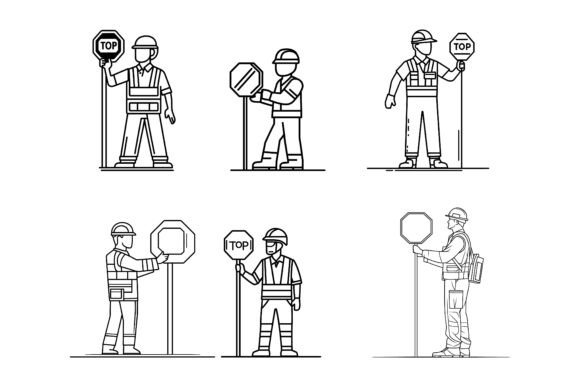
The Blueprint Behind the Build: The Unseen Artistry of Construction Workers
In the world of tangible creation, where structures rise from empty plots, the role of construction workers is foundational. They are the artisans of steel and concrete, translating complex blueprints into physical reality. Yet, this translation from plan to product often begins not on the site, but in the digital realm. The tools used to design, communicate, and market these projects have evolved, and at the heart of this evolution lies a need for precise, adaptable, and professional visual assets. This is where specialized digital illustration collections become a critical part of the modern construction workflow, serving not just the builders, but everyone connected to the industry.
Visual Communication in a Physical Industry
The construction industry is a symphony of coordination between architects, engineers, project managers, contractors, and clients. Clear communication is the scaffolding upon which successful projects stand. While technical drawings and Gantt charts are essential, there is a growing need for more accessible visual materials to explain concepts, showcase services, or enhance presentations. For instance, a construction firm’s website might need icons representing different trades—carpentry, electrical work, masonry. A safety manual requires clear symbols to denote hazards and protocols. A project proposal benefits from infographics that visually break down phases and timelines.
Traditional photography of construction workers and equipment is valuable, but it can be situationally limited. Custom digital illustration offers uniformity, clarity, and flexibility. A well-designed set of illustrations can depict a crane operator, a welder, or a team surveying a site with consistent style and detail, irrespective of weather, location, or availability of a photographer. This consistency builds a cohesive brand identity for firms and creates reliable visual language for educational materials aimed at teaching construction safety or trades.
The Engine of Editability: AI EPS Formats
For professionals who rely on these visuals, the file format is not a minor detail; it is a determinant of utility. Consider a collection advertised with the features: "Hello, welcome to our special AI EPS collections. What makes these AI EPS illustration sets special for you? Illustration. File includes - AI EPS and JPG - Designed for Mac and Windows users. Neatly organized file and layer structure. Perfection in details and consistency." This description highlights technical advantages critical for serious use.
The AI EPS file combination is particularly powerful. AI files are native to Adobe Illustrator, a industry-standard vector graphics software. EPS (Encapsulated PostScript) is a legacy but widely compatible vector format. Together, they guarantee that the illustration is a vector graphic. Unlike a pixel-based JPG (also useful for quick placement), a vector graphic is built from mathematical paths. This means it can be scaled infinitely without any loss of quality—from a tiny icon on a mobile app to a massive billboard print. The "neatly organized file and layer structure" is a pledge of efficiency. Each element of a complex illustration, like the tools in a construction worker's hands or the components of a scaffolding, is on a separate layer. This allows a designer to easily isolate, modify, or animate individual parts without deconstructing the entire image.
Bridging the Digital and Physical: Key Applications
The suitability for "print, web, symbols, apps, infographics" speaks to the universal utility of such assets. Let's observe their application through the lens of the construction sector.
- Print & Marketing: Company brochures, safety posters on site offices, trade magazine advertisements. The perfection in detail ensures crisp output even on large format prints.
- Web & Digital Presence: Website hero images depicting construction crews, service page icons, blog article graphics explaining construction processes. The scalability ensures fast loading and sharp display on all devices.
- Symbols & Signage: Creating custom symbols for site maps, safety warnings, or equipment labels. The editability allows quick color changes to match corporate or regulatory color codes.
- Apps & Software: User interface icons for construction management apps, project tracking tools, or educational software for vocational training. The consistency across a set creates a professional user experience.
- Infographics & Reports: Visualizing data on construction workforce demographics, project milestone achievements, or material usage statistics. Individual illustrated elements can be pulled from the set and combined into new informative graphics.
For a business owner running a construction firm, these illustrations can accelerate marketing material creation. For an educator teaching civil engineering, they provide clear, royalty-free visuals for course packs. For a hobbyist building a website about historic construction techniques, they offer professional assets without the cost of custom illustration.
The Advantage of Customization and Control
The promise that "you can edit it, change colors and modify the icon so easily according to your needs" addresses a core pain point. Brand alignment is crucial. A generic illustration of a construction worker in a red hard hat might not match a company whose brand color is blue. With a layered vector file, changing the hat color is a matter of seconds. Perhaps an illustration shows a worker using a specific tool type; a firm specializing in different equipment can modify the tool. This level of control transforms a purchased asset from a static image into a flexible visual resource that can evolve with the organization's needs.
This editability also supports inclusivity and representation. Illustrations can be modified to reflect diverse crews, different types of personal protective equipment, or region-specific construction methods, making the visuals more authentic and relatable.
Considerations for Integration into Workflows
While the benefits are clear, effective integration requires consideration. Professionals should ensure their team or chosen designer has access to and proficiency with software like Adobe Illustrator to fully leverage the AI EPS files. The JPG versions serve as useful placeholders or for use in environments where vector editing is not needed, such as some content management systems or simple document editors.
The "perfection in details and consistency" across a set is a quality metric. In construction, details matter—the correct depiction of a safety harness, the accurate shape of a tool. Inconsistent or poorly detailed illustrations can undermine the credibility of the material they are used in. Therefore, evaluating the artistic accuracy and technical detail of an illustration set, just as one would evaluate the specs of a material, is important.
Finally, the ethical use of such assets is straightforward but worth noting. They are typically offered for commercial use, allowing firms to enhance their communications without the recurring costs of stock photo subscriptions or the legal complexities of licensing individual images. However, understanding the specific license of the collection is always recommended.
Beyond the Purchase: The Real-World Impact
The call to action "So what are you waiting for? Buy now and start using this awesome illustration" underscores immediacy. But the true value is realized not in the purchase, but in the application. When a construction safety NGO uses these illustrations to create clearer training manuals, the impact is safer worksites. When a small contracting company uses them to build a more professional website, the impact is more client trust and potentially more business. When an app developer uses them to create a better tool for project managers, the impact is increased efficiency on real construction projects.
In this way, high-quality, editable digital illustration sets become a subtle but powerful tool in the ecosystem of construction. They help bridge the gap between the highly technical, physical work of construction workers and the digital world of planning, communication, education, and marketing that supports it. They allow the story of the industry—its people, its processes, its achievements—to be told with clarity, consistency, and professional polish, benefiting everyone from the project manager in a high-rise office to the apprentice learning their trade on the ground.