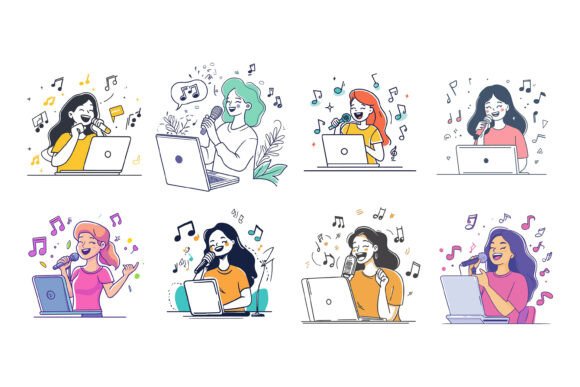
Girl Listening Music with Headphone – AI EPS Illustration Set
Finding the right visual to capture a feeling like getting lost in music can be trickier than it seems. You might browse through dozens of stock libraries, only to end up with a generic, stiff graphic that lacks soul. A girl listening to music with headphones isn't just a decorative image; it’s a symbol of focus, creativity, and personal escape. Whether you're designing a podcast cover, building an app interface, or crafting a blog header, the illustration you choose says a lot about your attention to quality. What often gets overlooked is that not all illustrations are built the same way behind the scenes. Some look great in a preview but become a pixelated mess when you try to resize them for print. Others claim to be editable but deliver a tangled mess of unlabeled layers that wastes hours of your time.
This particular AI EPS illustration set — centered on a girl immersed in her headphones — was designed to solve exactly those hidden frustrations. It comes with a carefully structured file package that includes AI, EPS, and JPG formats, making it immediately useful for both macOS and Windows users. The difference between a file you can actually work with and one that fights you at every turn often lies in the layer organization. Here, every element is neatly arranged, so you can isolate headphones, hair, clothing, or background shapes without digging through dozens of unnamed paths. That might sound like a small detail, but it’s the kind of thing that turns a ten-minute edit into a two-hour headache when it’s missing.
Why the Wrong Music Illustration Can Hurt Your Project
A common mistake people make is treating all vector illustrations as interchangeable. You might download a free graphic of a person with headphones, only to find that the colors clash with your brand palette, and the file wasn’t constructed with easy recoloring in mind. Trying to change a shade of blue then becomes a manual process of hunting down every stray path. Another overlooked issue is consistency. If you’re building a series of infographics or app screens, using illustrations from different creators can make the final result feel disjointed. One might have thick outlines, another thin, one realistic proportions, another cartoonish. The jarring effect undermines the professional image you’re trying to project.
Poor file structure also affects how well the artwork performs across different media. A JPG might be fine for a small web thumbnail, but when you need to blow it up for a poster or brochure, the difference between a crisp vector and a low-resolution raster image becomes painfully obvious. Many beginners don’t realize that the blurry result isn’t their design software's fault — it’s a sign they started with the wrong base file. With a genuine EPS or AI file, you maintain razor-sharp clarity at any size, from a tiny app icon to a billboard.
What Sets a Well-Built AI EPS Set Apart
When you open an illustration file and everything is logically named — “headphone-left,” “face-highlight,” “music-note-1” — you immediately feel in control. You aren’t guessing. You can click on an object, change its fill, adjust a stroke, and see the result in seconds. That’s the experience this girl listening to music with headphones illustration is built on. The designer paid attention to detail not only in the artwork itself, but in how the file is assembled. This perfection in details and consistency means each curve flows naturally, the headphones sit realistically on the head, and the overall pose feels genuine rather than awkwardly posed.
Another practical advantage many overlook is cross-platform readiness. Files that work smoothly on a Mac often break or misbehave on Windows, and vice versa, if they weren’t properly prepared. By including both AI and EPS formats, this set sidesteps that problem. AI gives you full native editing power if you use Adobe Illustrator, while EPS offers a more universal vector format that plays nicely with CorelDRAW, Affinity Designer, and other tools. The JPG file acts as a quick preview or an instant-use raster version for scenarios where you don’t need to edit anything.
Common Editing Mistakes and How to Avoid Them
One of the most frustrating experiences is opening an illustration, trying to change a single color, and accidentally breaking the entire design because elements are grouped in strange ways or masked incorrectly. You might find that the shadow layer is somehow locked into the background, or that the line art is expanded into thousands of individual segments. The better approach is to start with an illustration set that has been built with editing in mind from the start. When you can easily modify colors, adjust the composition, or repurpose parts of the illustration — like pulling just the headphones to use as a standalone icon — the asset becomes far more valuable than a flat, unchangeable picture.
Think about a real-world example. A small business owner wants to create a social media post announcing a new playlist feature. She downloads this vector of a girl listening to music through headphones, changes the background to match her brand’s warm orange, tweaks the clothing color to echo her logo’s accent, and adds a simple text overlay. The whole process takes under ten minutes because the file is clean. If she had picked a poorly structured free graphic, the recolor could have taken an hour, introduced artifacts, or forced her to live with a color she didn’t love. That direct impact on time and creative freedom is often what separates a good resource from a mediocre one.
Before You Choose a Music-Themed Illustration: What to Check
There are several boxes you should tick before downloading or purchasing any vector asset, whether you're a marketer, a blogger, or an app developer. The first is file format flexibility. You’ll want at least one fully editable vector format and a high-quality raster preview. Ask yourself: can I open this on the device and software I use daily? If you’re collaborating with others, will the file move across platforms without issues? The girl listening to music with headphone set addresses this by being designed for both Mac and Windows users, with widely compatible standards.
Scalability should be non-negotiable. If you can’t scale the image to a large print size without losing crispness, you’ll hit a wall sooner or later. The AI and EPS files are true vectors, meaning you can enlarge them to any dimension without a hint of blurriness. Another overlooked factor is licensing and usage rights. You need to know if the illustration is suitable for commercial work, mobile apps, print-on-demand products, or client projects. A good set will clearly grant you broad usage rights, freeing you from worrying about whether your new website header or product label crosses a legal line.
Check the internal structure if you possibly can. Even a well-reviewed illustration can disappoint if the layers are messy. Look for descriptions that mention neat organization or per-item labeling. This set’s file structure is designed so that each element is easy to find and alter. It’s the kind of transparency that saves you from the sinking feeling of opening a file only to see “Layer 1,” “Layer 2,” and fifty unnamed paths.
Practical Applications Where This Illustration Shines
You might not realize how many projects can benefit from a single, well-made illustration. A music podcast can use the girl with headphones as a hero image on its landing page or as cover art across platforms. An educational tech company could place her in an app onboarding screen, teaching users how to listen to audio lessons. A freelance designer creating an infographic about the benefits of focus might use the illustration as a central metaphor, extracting just the headphone-wearing head to represent deep work. Because the file is editable, you can recolor the entire character to match a corporate palette or simplify it into a minimalist two-tone symbol for an app navigation bar.
Think about a marketer promoting a wellness app that includes a music library for meditation. Instead of commissioning original art from scratch — which can take days and cost hundreds of dollars — they can purchase this AI EPS set, adjust the colors to something soft and calming, and have a professional result by the afternoon. The consistency in the design means it won’t look out of place next to a clean, modern UI layout. This kind of flexibility is often missing from cheaper or free alternatives that force you to accept the original color scheme and style without any meaningful room for personalization.
Another scenario involves an event organizer creating printed banners for a silent disco event. The graphic needs to be enormous, vibrant, and eye-catching. Using a JPG pulled from the web would result in a muddy, pixelated print that screams amateur hour. With the EPS file, the image stays pin-sharp even at poster size, and the ability to tweak colors means the illustration can perfectly echo the event’s theme. The same file can then be resized for digital tickets and social media promotions, maintaining a cohesive look across all touchpoints.
Making the Most of Your AI EPS Illustration
Once you have the file open, resist the temptation to overload the design. A common misstep is applying too many effects or cluttering the composition with additional elements that fight for attention. The illustration’s strength is its clean, focused portrayal of a music-loving moment. If your layout demands extra graphics, pull individual parts from the carefully organized layers — maybe a few floating music notes or subtle sound waves — rather than importing something clashing from another source. Keeping things visually cohesive starts with one high-quality base asset and thoughtful restraint.
You can also use the illustration as a learning tool if you’re new to vector editing. Because the layers are so neatly arranged, you can study how a professional constructs shadows, gradients, and highlights. Click through the objects, see how they overlap, and you’ll pick up techniques that improve your own drawing skills. It’s an unexpected bonus that comes from choosing an asset built with care.
If you've ever had to scrap a design because the central image just wasn't working, you know how costly that can be in terms of time and morale. Starting with an editable, detailed, and adaptable illustration like this girl listening to music with headphones reduces that risk dramatically. The consistency in line weights, the realistic pose, the thoughtful layer structure, and the multi-format delivery all add up to a smoother workflow. Before you commit to any other option, compare what you’re actually getting under the hood. A pretty preview often hides a messy reality, and without editability, you’re stuck with someone else’s creative choices. When you can open a file, understand it instantly, and shape it to fit your exact vision, you’ve found a tool that genuinely serves your project.